Showing posts with label Foot and Ankle. Show all posts

Monday, August 29, 2011

Joint Mobilization in the Foot and Ankle

Joint mobilization is a technique that is often used in the rehabilitation of foot and ankle injuries. It involves the passive movement of a joint by a trained professional, often a physical therapist or a doctor. Joint mobilization is generally categorized into five different types of mobilization. The five grades of joint mobilization are classified based on the mechanoreceptors being activated.

Grade I joint mobilization is directed towards cutaneous mechanoreceptors, and the motion involves a minimal amount of tension on the joint through oscillation. Grade II is similar to Grade I, but has a higher amount of tension placed through the joint and affects a greater amount of mechanoreceptors. Grade III selectively activates more of the joint and muscle mechanoreceptors and less of the cutaneous receptors. Grade IV has a sustained movement at the end range of motion at the joint, and is targeted more towards the slow adapting mechanoreceptors of the joints and tendons. Grade V joint mobilization is also referred to as a manipulation, and involves a more rapid movement of the joint at its end range of motion.

Often times there is a limitation in motion at the ankle joint as a result of injury or prolonged immobilization secondary to surgery or casting. Limited range of motion in the direction of dorsiflexion is referred to as equinus, and is often the cause of foot problems and pain. Research has shown that joint mobilization at the ankle joint can help improve range of motion. A study by Green et al. in 2002 showed that patients who sustained an acute inversion ankle sprain, when treated with certain types of mobilizations of the ankle showed improvement in pain levels and functional outcomes. Similarly, Landrum et al. showed an improvement in range of motion following prolonged immobilization of the ankle. Dorsiflexion following joint mobilization was improved.

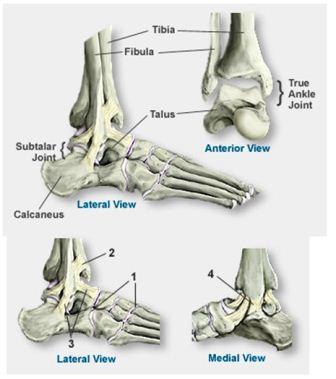
Joint mobilization of the ankle joint is typically done in combination with the subtalar joint, as these two joints work closely together during movement of the ankle and rearfoot, and are commonly both injured in strains and sprains. It is generally combined with muscle strengthening and stretching exercises that will also help to improve range of motion and lead to a better functional outcome. A rehabilitation program is typically devised between the doctor and the patient following an injury to the foot and ankle, or in cases of surgical reconstruction following trauma or a chronic condition.


Central Florida Foot and Ankle Center
101 6th St Nw
Winter Haven, Fl 33881
Phone: (863) 299-4551
www.FLFootandAnkle.com

Friday, May 28, 2010

Rheumatoid Arthritis of the Foot and Ankle

Rheumatoid arthritis is an autoimmune disease that affects multiple joints of the body. While it is more common for the first joints involved to be of the hand and wrist, roughly 90% of rheumatoid arthritis patients will eventually develop symptoms in the foot and ankle. Symptoms of rheumatoid arthritis include pain, swelling, and stiffness of the joints. Most commonly, the joints affected will be on both the right and left feet. When rheumatoid arthritis affects the foot, it usually will begin with symptoms in the joints of the toes, and work its way up the hindfoot and ankle.

Occasionally, rheumatoid arthritis may present for the first time in the foot and ankle. The symptoms of joint pain and swelling will be present, as well as some of the systemic effects such as loss of appetite, fever, and fatigue.

If your doctor suspects rheumatoid arthritis, X-rays will usually be taken to rule out other causes, as well as to establish a baseline for the structure of the foot. Because rheumatoid arthritis is a progressive disease, deformities of the foot and ankle or hands and wrist can be tracked using X-rays.

A simple blood test may also be performed to look for the antibody known as rheumatoid factor, which is present in the vast majority of cases.

When comparing rheumatoid arthritis to osteoarthritis (degenerative joint disease, also known simply as arthritis), there are several key differences of note. Rheumatoid arthritis is an inflammatory form of arthritis. This means that the tissue surrounding the joint space (the synovium) is actually inflamed, unlike the joints in osteoarthritis. Also, rheumatoid arthritis is typically progressive, and will involve first the small joints of the hands and feet. It is also common to rheumatoid arthritis affecting both limbs (right and left).

Rheumatoid arthritis of the foot and ankle is treated in the same fashion as rheumatoid arthritis of the hands. Medication for pain control (such as ibuprofen or aspirin) along with exercise may be enough to ward off the symptoms for some patients; others will require more intensive therapy such as steroid injections into the effected joints. Methotrexate, prednisone, sulfasalazine and other medications can be used as well to help slow the spreading of the disease.

Changes to shoes are a common practice, as many patients with rheumatoid arthritis will need a wider or deeper shoe to accommodate their feet.

Surgical options may be considered by your doctor to address foot deformities associated with rheumatoid arthritis. Common deformities of the foot include bunions and hammertoes, which can create a painful situation. Surgical correction may also include joint replacement or other therapies. These options can only be decided by you and your doctor together.


Central Florida Foot and Ankle Center
101 6th St Nw Winter Haven, Fl 33881
Phone: (863) 299-4551

www.FLFootandAnkle.com